
VOC Emissions in Industrial Coding & Marking: Why More Thai Manufacturers Are Evaluating TIJ and CIJ Technologies

Understanding VOC Emissions in Industrial Printing Applications in Thailand
Across Thailand's manufacturing sector, environmental responsibility is becoming increasingly important. Food processors, beverage manufacturers, pharmaceutical companies, cosmetics producers, and FMCG brands are all under growing pressure to improve sustainability while maintaining efficient production operations.
One area that is often overlooked is the coding and marking process used to print production dates, expiry dates, batch numbers, lot codes, barcodes, and QR codes onto packaging.
While coding information may occupy only a small area of a package, the printing technology selected can have a significant impact on solvent consumption and Volatile Organic Compound (VOC) emissions.
As many Thai manufacturers continue to modernize their production facilities, understanding the VOC impact of different coding technologies has become an important consideration when selecting between Continuous Inkjet (CIJ) and Thermal Inkjet (TIJ) systems.
What Are VOCs?
VOC stands for Volatile Organic Compounds.
These are organic chemicals that evaporate into the atmosphere during normal operation. Many industrial inks contain solvents that are classified as VOCs.
When released into the air, VOCs can contribute to air pollution and environmental concerns. As sustainability initiatives become more common across Thailand's manufacturing industry, many factories are beginning to evaluate not only printing performance but also the environmental impact of their coding systems.
Today, multinational companies operating in Thailand frequently include sustainability targets, solvent reduction programs, and environmental performance indicators as part of their supplier and manufacturing requirements.
As a result, VOC emissions are becoming a factor in equipment selection decisions.
Why VOC Emissions Matter for Thai Manufacturers
In Thailand, many production facilities operate 24 hours per day, 7 days per week.
Industries such as:
Food & Beverage
Pet Food
Dairy Products
Pharmaceutical Manufacturing
Personal Care & Cosmetics
Consumer Goods (FMCG)
Packaging Converters
often consume significant quantities of printing ink every year.
When production volumes increase, even small differences in ink consumption can translate into substantial differences in annual VOC emissions.
This is particularly relevant for facilities seeking to:
Reduce environmental impact
Improve workplace conditions
Lower solvent consumption
Support ESG initiatives
Meet sustainability objectives from multinational headquarters
How VOC Content Is Calculated
The potential VOC content of an ink can generally be estimated using two key values found in the technical data sheet or safety data sheet:
Specific Gravity
Percentage of VOC Components
The basic formula is:
VOC Weight = Specific Gravity × VOC Percentage
For example:
If an ink has:
Specific Gravity = 0.87
VOC Content = 84%
Then:
VOC Weight = 0.87 × 0.84
= 0.7308 g/mL
This means every milliliter of ink potentially contains approximately 0.73 grams of VOC material.
To determine total VOC emissions, manufacturers simply multiply this value by the total ink consumption over a given period.
How Continuous Inkjet (CIJ) Technology Works
Continuous Inkjet (CIJ) printers are widely used throughout Thailand's manufacturing industry.
The technology operates by continuously generating a stream of charged ink droplets.
Only a small percentage of these droplets are used for actual printing, while the remaining droplets are collected and recycled back into the system.
Because CIJ inks are solvent-based, evaporation naturally occurs during operation.
To maintain correct viscosity levels, CIJ systems continuously add make-up fluid (solvent) to compensate for solvent loss.
This process is one reason why CIJ systems typically consume both ink and make-up fluid during operation.
Popular applications in Thailand include:
Beverage bottles
Plastic packaging
Flexible films
Glass containers
Metal cans
Building materials
Wire and cable production
CIJ remains one of the most versatile coding technologies available and is often selected for high-speed production environments.
How Thermal Inkjet (TIJ) Technology Works
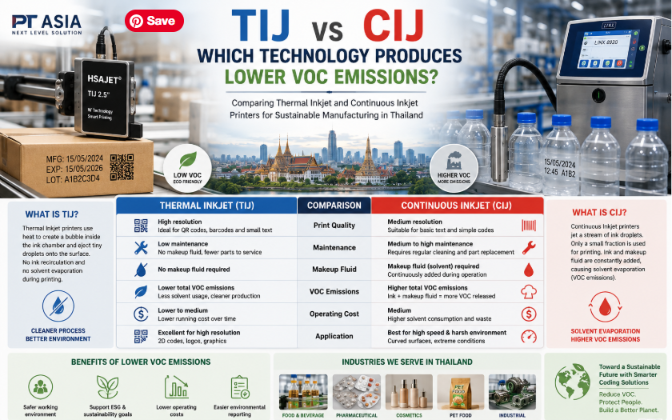
Thermal Inkjet (TIJ) technology operates differently.
Inside each print cartridge are microscopic chambers containing heating elements.
When a print signal is received, a small amount of ink is rapidly heated, creating a vapor bubble that ejects a precise droplet of ink onto the product surface.
Unlike CIJ systems, TIJ printers do not require continuous circulation of ink or make-up solvent.
This design significantly reduces complexity and eliminates the need for viscosity control systems.
Advantages often associated with TIJ include:
High print resolution
Maintenance-free operation
No ink pumps
No make-up fluid
Reduced operator intervention
Simplified installation
For many secondary packaging applications such as cartons, labels, trays, sleeves, and shipping boxes, TIJ technology has become increasingly popular in Thailand.
Comparing VOC Emissions Between TIJ and CIJ
For challenging substrates such as plastic, metal, and glass, both TIJ and CIJ technologies may require solvent-based inks.
As a result, VOC content per milliliter of ink can appear similar when comparing ink formulations alone.
However, the key difference lies in overall fluid consumption.
A CIJ system typically requires:
Ink
Make-up solvent
whereas a TIJ system only consumes the ink contained within the cartridge.
This additional make-up fluid can significantly increase the total VOC emissions associated with CIJ operation.
Based on comparative calculations presented in the source material, printing the same amount of information may require substantially more total fluid consumption from a CIJ system than from a comparable TIJ solution. In certain applications, overall VOC release can be several times higher due to the additional make-up solvent required during continuous operation.
Which Technology Is Best for Thai Manufacturers?
There is no single technology that fits every application.
The correct choice depends on:
Choose CIJ When:
Extremely high production speeds are required
Printing on curved products
Printing on moving bottles and containers
Harsh industrial environments
Continuous 24/7 production lines
Choose TIJ When:
High-resolution printing is required
Maintenance reduction is important
Solvent consumption needs to be minimized
Lower operating complexity is preferred
Cartons, labels, trays, and secondary packaging are being coded
Many modern factories in Thailand now operate both technologies simultaneously, selecting the most suitable solution for each production line.
Future Trends in Thailand's Manufacturing Sector
As sustainability becomes increasingly important, more Thai manufacturers are evaluating total operating costs rather than simply comparing equipment purchase prices.
Factors such as:
Ink consumption
Solvent usage
VOC emissions
Maintenance requirements
Production efficiency
Environmental impact
are now influencing investment decisions.
The transition toward smarter, cleaner, and more sustainable production facilities is expected to continue across Thailand's food, pharmaceutical, cosmetic, and FMCG sectors over the coming years.
Conclusion
VOC emissions are becoming an increasingly important consideration when selecting industrial coding and marking equipment.
While both Continuous Inkjet (CIJ) and Thermal Inkjet (TIJ) technologies remain valuable solutions for industrial production, manufacturers should evaluate not only print quality and production speed but also solvent consumption and environmental impact.
By understanding the relationship between ink consumption, make-up fluid usage, and VOC emissions, Thai manufacturers can make more informed decisions that support both operational efficiency and long-term sustainability goals.
PT Asia provides a comprehensive range of coding and marking solutions including CIJ, TIJ, Laser Marking, and high-resolution printing systems, helping manufacturers across Thailand select the most suitable technology for their production requirements.



Comments