
TIJ vs CIJ Printers: Which Coding Technology Produces Lower VOC Emissions for Sustainable Manufacturing in Thailand?

Sustainability has become a major focus for manufacturers across Thailand. Whether producing food, beverages, pharmaceuticals, cosmetics, pet food, or industrial products, manufacturers are under increasing pressure to reduce environmental impact while maintaining production efficiency.
One area that is often overlooked is product coding and marking technology.
Every production line requires batch codes, expiry dates, manufacturing dates, lot numbers, barcodes, QR codes, and traceability information. However, not all coding technologies have the same environmental footprint.
Today, many Thai manufacturers are evaluating the environmental impact of Continuous Inkjet (CIJ) and Thermal Inkjet (TIJ) printing systems, particularly regarding Volatile Organic Compound (VOC) emissions.
Understanding VOC emissions can help factories improve workplace safety, reduce environmental impact, and support sustainability initiatives.
What Are VOCs?
VOC stands for Volatile Organic Compounds.
These are organic chemicals that easily evaporate into the atmosphere at room temperature. Many industrial solvents used in printing inks contain VOCs.
High VOC emissions may contribute to:
Air pollution
Worker exposure to solvent vapors
Environmental compliance concerns
Increased ventilation requirements
Sustainability reporting challenges
As Thailand continues to strengthen environmental awareness and ESG initiatives, VOC reduction is becoming increasingly important in manufacturing facilities.
Why VOCs Matter in Industrial Coding Applications
Coding and marking equipment operate continuously throughout production shifts.
In many factories, printers run:
8 hours per day
16 hours per day
24 hours per day
Even small differences in ink consumption can create significant differences in VOC emissions over time.
For high-volume manufacturers in Thailand's food, beverage, pharmaceutical, and consumer goods industries, selecting the right coding technology can contribute to long-term sustainability goals.
Understanding Continuous Inkjet (CIJ) Technology
Continuous Inkjet (CIJ) printers generate a continuous stream of electrically charged ink droplets.
Only a small percentage of droplets are actually used for printing.
The remaining droplets are recirculated back into the printer.
Because CIJ inks are solvent-based, evaporation continuously occurs during operation.
To maintain correct ink viscosity, CIJ systems automatically add makeup fluid (solvent) throughout the printing process.
Common CIJ applications include:
Beverage bottles
Food packaging
Plastic containers
Metal cans
Flexible packaging
Wire and cable marking
Industrial products
Popular CIJ printers in Thailand include the Linx 8900 Series, Linx 8920, Linx 8940, and other industrial coding systems.
Understanding Thermal Inkjet (TIJ) Technology
Thermal Inkjet (TIJ) printers use microscopic heating elements inside a cartridge.
When activated, the heater creates a vapor bubble that ejects a precise ink droplet onto the substrate.
Unlike CIJ technology:
No ink recirculation is required
No makeup solvent is required
No viscosity control system is required
Less routine maintenance is needed
TIJ technology has become increasingly popular in Thailand for:
Cartons
Corrugated boxes
Labels
Pouches
Pharmaceutical packaging
QR code printing
GS1 Sunrise 2027 compliance projects
VOC emissions can be estimated using two parameters:
1. Specific Gravity
The density of the ink.
2. VOC Percentage
The percentage of ingredients classified as VOCs.
The formula is:
VOC Weight = Specific Gravity × VOC Percentage
This provides the amount of VOC emitted per milliliter of ink used.
According to industry data, a typical MEK-based CIJ ink may contain approximately 90% VOC content, while makeup fluid can contain nearly 100% VOC content. Certain TIJ solvent-based inks may also contain VOCs, but the total system consumption is often significantly lower because no makeup fluid is required.
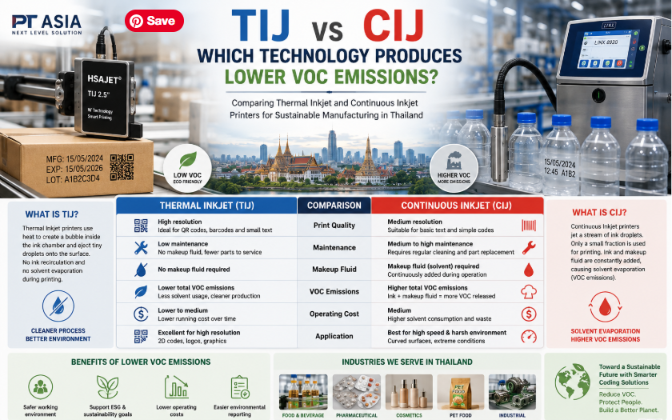
Comparing VOC Emissions: TIJ vs CIJ
The most important difference is not simply the VOC content of the ink itself.
The key factor is total fluid consumption.
CIJ systems require:
Ink
Makeup fluid
Continuous solvent replenishment
TIJ systems typically require:
Ink cartridge only
Industry calculations indicate that printing the same amount of information may require significantly more total solvent consumption in a CIJ system due to makeup usage. This can lead to substantially higher overall VOC emissions when compared with TIJ technology.
Benefits of Lower VOC Emissions
Improved Workplace Environment
Reducing solvent emissions helps create a cleaner production environment.
Sustainability Goals
Many multinational manufacturers operating in Thailand have established ESG targets that include emission reduction programs.
Reduced Consumable Usage
Less solvent consumption often translates into lower operating costs.
Simplified Environmental Reporting
Lower VOC emissions can support environmental reporting initiatives and sustainability audits.
Which Industries in Thailand Benefit Most?
Food and Beverage
Manufacturers printing expiry dates on:
PET bottles
Cartons
Flexible packaging
Metal cans
Pharmaceutical
High-quality coding requirements combined with environmental compliance objectives.
Cosmetics and Personal Care
Many cosmetic manufacturers are seeking cleaner production technologies.
Pet Food Manufacturing
Thailand's rapidly growing pet food industry increasingly focuses on sustainability and traceability.
Export Manufacturers
International customers often evaluate suppliers based on environmental performance and ESG initiatives.
Choose CIJ When:
Very high production speeds are required
Printing on challenging curved surfaces
Harsh industrial environments
Extremely small character printing
Choose TIJ When:
High-resolution codes are required
QR codes are important
Maintenance needs must be minimized
VOC reduction is a priority
Sustainability initiatives are a key objective
The best solution depends on the production environment, substrate type, line speed, and business objectives.
Future Trends in Thailand's Manufacturing Sector
Thailand's manufacturing industry is moving toward:
Smart factories
Digital traceability
GS1 Sunrise 2027 compliance
Sustainability reporting
Carbon reduction initiatives
ESG compliance
As these trends continue, environmental considerations will increasingly influence coding technology selection.
Many manufacturers are no longer evaluating printers solely on purchase price. They are considering total cost of ownership, maintenance requirements, energy consumption, and environmental impact.
Conclusion
VOC emissions are becoming an increasingly important consideration for manufacturers in Thailand.
While both CIJ and TIJ technologies remain valuable coding solutions, their environmental impact differs significantly due to the way each technology operates.
For manufacturers focused on sustainability, reducing solvent consumption, improving workplace conditions, and supporting ESG initiatives, understanding VOC emissions should be part of the printer selection process.
Before investing in a new coding and marking system, manufacturers should evaluate not only print quality and speed but also long-term environmental performance and total operating costs.
PT Asia provides coding and marking solutions for food, beverage, pharmaceutical, cosmetics, pet food, and industrial manufacturing applications throughout Thailand. Our specialists can help evaluate the most suitable technology based on your production requirements, sustainability goals, and traceability needs.


Comments